cloudnineair.com

Cloud 9 AC Services
Heating and air · Winter Garden
Service-area town pages that Google already sends clicks to.
measured:PageSpeed, mobile / desktop 100 / 99, 2026-11-04 (Google PageSpeed Insights)
The web practice
Six live sites, each in a different industry: Cloud 9 AC Services (heating and air), Everyday Cigar Club (a cigar store with a subscription club), Daniel's Cheesesteaks (three restaurants with online ordering), Ripz & Sipz (vending), Platoon Wave (a veterans nonprofit) and fusionpayments.com (our own site). Static builds served from the edge, the checkout and the invoice link on the same stack as the card processing, and one phone number when anything breaks.
six live sites · static · edge-served · rollback rehearsed
Fusion Payments — Built by Fusion
Each one is a different kind of business, which is the point: the build changes, the stack underneath does not. Every site below is live today; click through and read it at its own address.
Heating and air · Winter Garden
Service-area town pages that Google already sends clicks to.
measured:PageSpeed, mobile / desktop 100 / 99, 2026-11-04 (Google PageSpeed Insights)
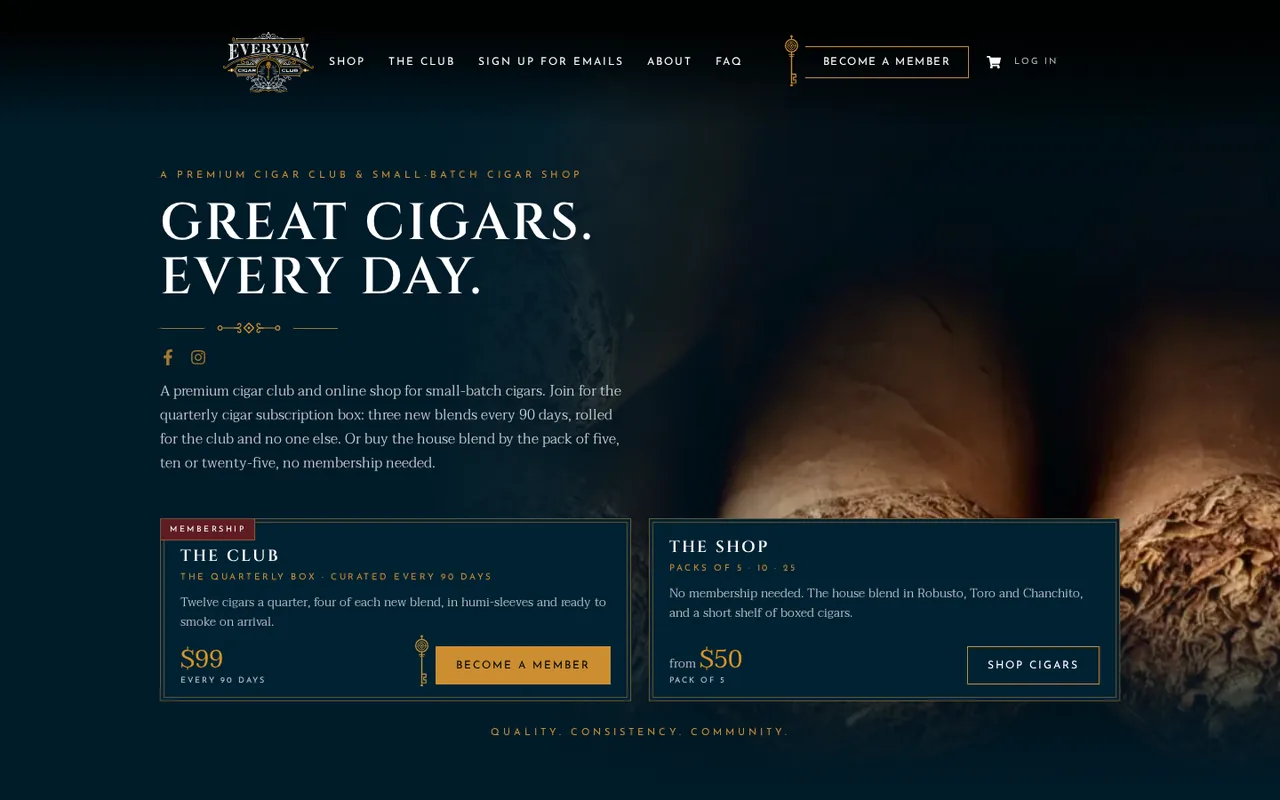
Retail and online store
A cigar store with a subscription club, a live cart and a quarterly blend rotation.

Restaurant · three locations
One site, three locations, one router that sends each order to the right kitchen.
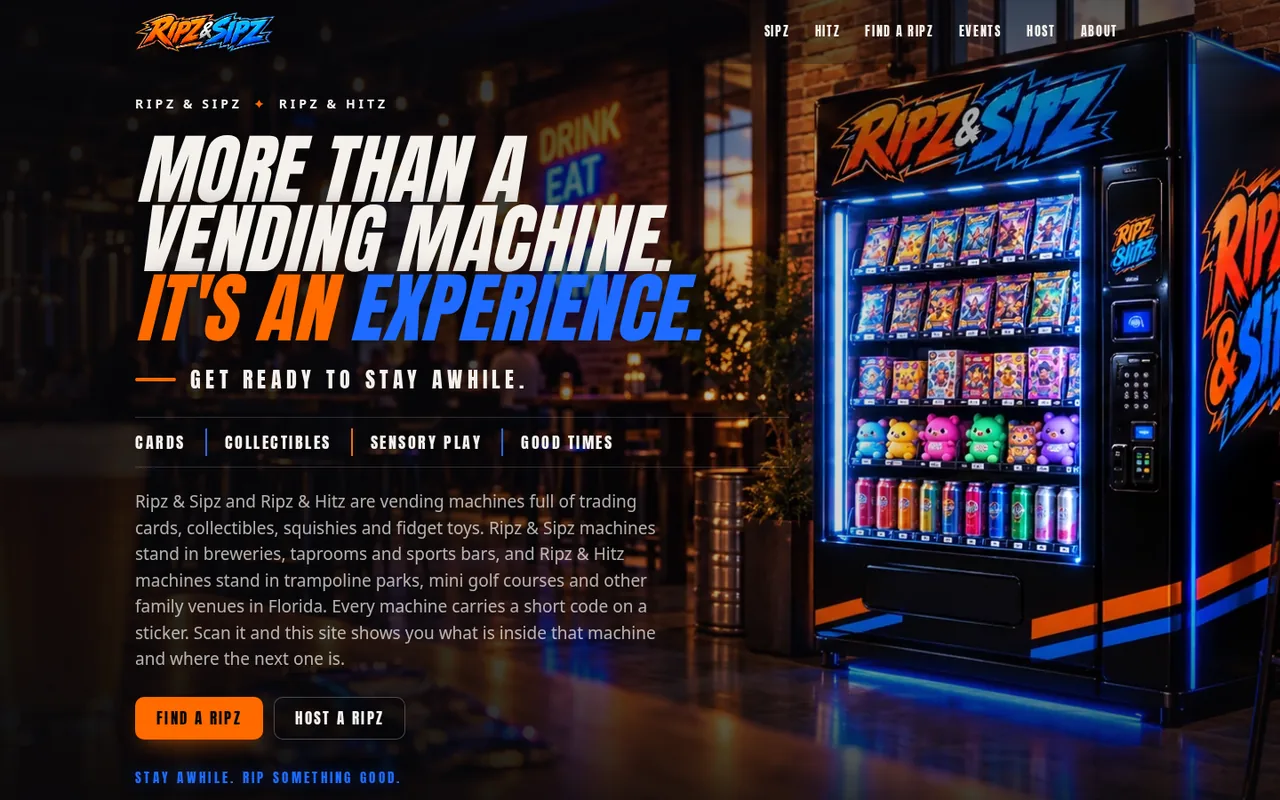
Vending · Central Florida
A vending company's site with a shop built in and an inquiry funnel that lands with a person, not a mailbox.

Veterans nonprofit
A giving page on the same rail as the processing, so the donor never leaves the site.
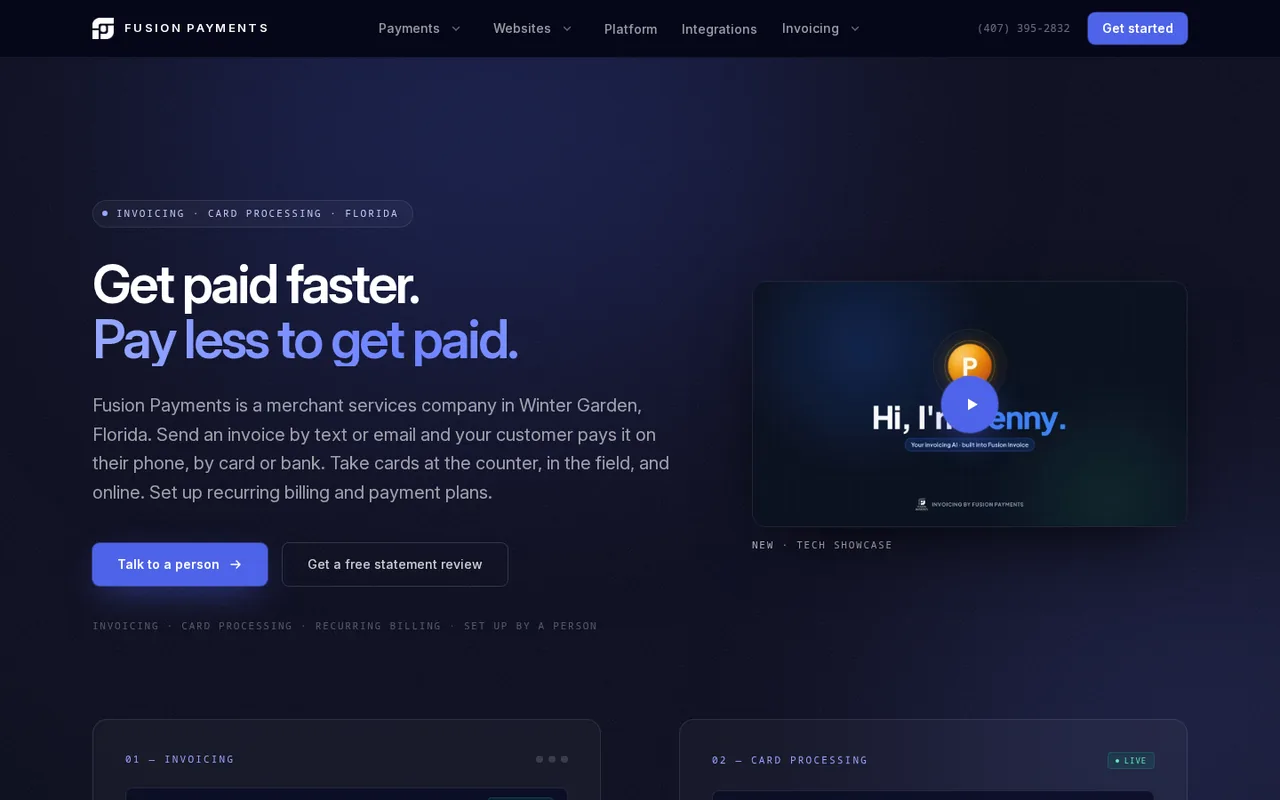
Payments · our own site
The page you are reading. Same pipeline, same edge, same team.
*Case records with a client's numbers publish only when that client signs off; none are released yet. References are arranged as a call.
Fusion Payments — The craft
A slow site taxes every dollar you spend getting someone to it. Fusion builds static-first, serves from the edge, and treats performance as a line item in the plan — measured on every release, not promised once.
The site compiles to static files served from a global edge network — there is no origin server to slow down, fall over, or patch at 2 a.m. Hosting is part of the engagement, run by the people who built the site.
serve: static from the edge · TLS managed · no origin to fail
Every change is version-controlled, built, and staged before it goes anywhere near production. Releases are tagged and rollback is rehearsed, not theoretical — the same discipline the payment stack gets.
release: tagged → staged → live · rollback rehearsed
Page weight and interactivity are budgeted per page and checked on every release. When a change would make the site slower, the build says so before your visitors do.
budget: weighed per release · tested at real widths
The domain, the content, and the design are yours. If we ever part ways, the site goes with you — that is in the agreement, not a promise made on a call.
owned: domain · content · design — portable by contract
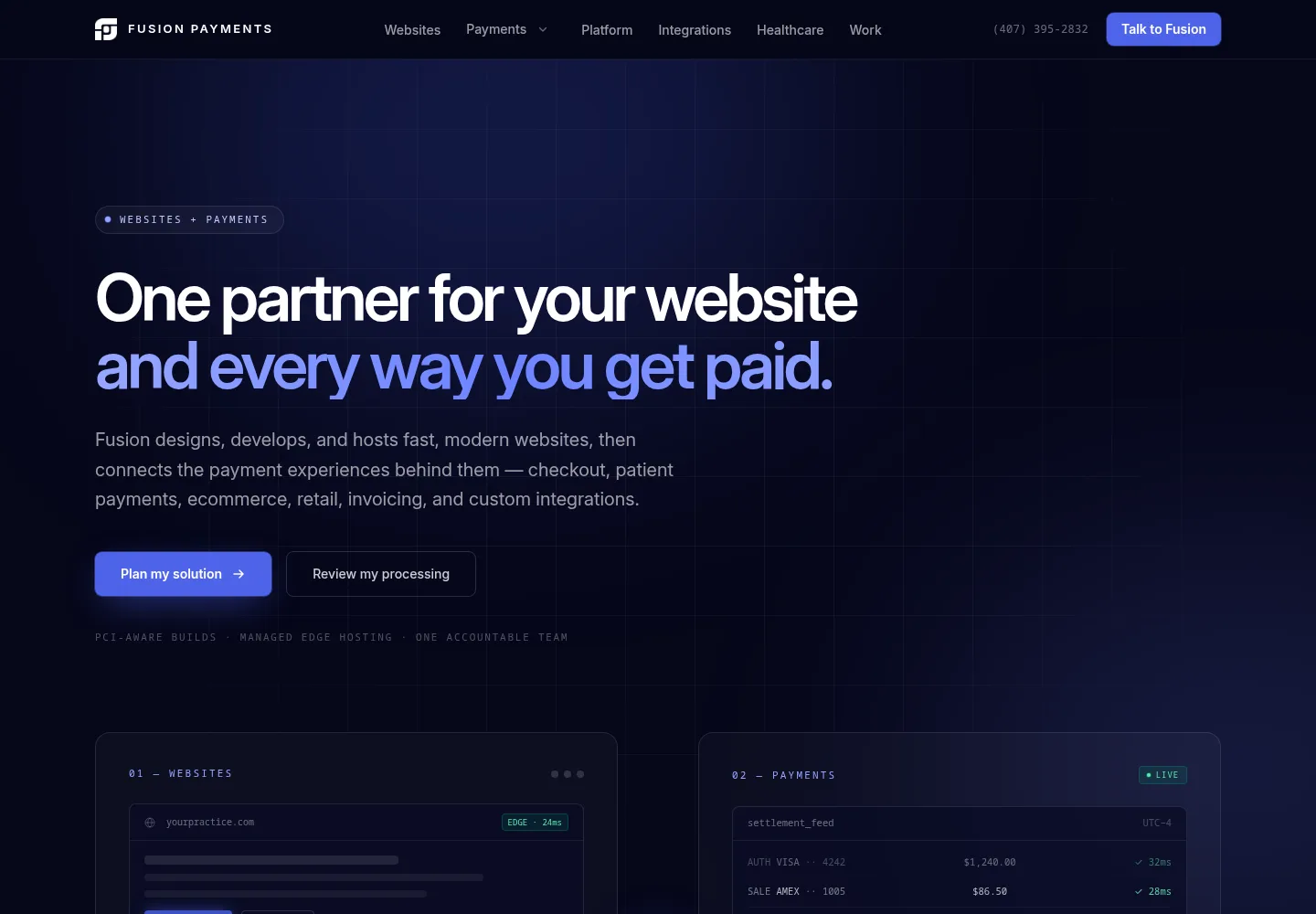
note: The page you are reading is the reference build: static, edge-served, payments wired in. We run our own stack before we sell it.
* Practices, not score guarantees — performance budgets are set per project in the build plan and verified on release. Ask to see a release log.
How Fusion works
Every phase ends in an artifact you sign. Nothing advances on a status call, and nothing is rebuilt later because nothing moves forward unfinished.
Phase 01 · WK 00–02
Map the customer, patient, payment, and operational journey as it exists today.
on the table: processing statements · quote-to-cash · the site as it stands
Gate 01 → 02 · admits: the journey map — one page, signed by both sides · nothing else
Phase 02 · WK 02–04
Select the processing, invoicing, hardware, and integration path that fits.
decided here: modules · hardware · integration path — priced, in writing
Gate 02 → 03 · admits: the build plan — scoped, priced, approved · nothing else
Phase 03 · WK 04–08
Board, configure, train, and launch — with a person on the phone the whole way.
discipline: tagged → staged → live · rollback rehearsed — CTRL-03
Gate 03 → 04 · admits: the live system — verified against the plan · nothing else
Phase 04 · WK 08 →
Support the system and add durable enhancements as the organization changes.
exit criterion: none — this phase does not close
04 feeds 01 · when the business changes — new location, new system, new way of getting paid — discovery re-opens. The team it re-opens with does not change.
* Weeks shown are typical for a standard build; integrations widen the windows, never the order. Three gates, three signatures — the only phase without an exit criterion is the last one. That is what accountable means on a timeline.
Payments-native
Most sites hand the visitor to a processor at the exact moment money appears. A Fusion build never leaves the rail — the checkout, the invoice link, and the donor page are stages of one system, run by one team.
Payment pages and embedded checkout are part of the build, not an iframe bolted on after — same typography, same domain, same accountability.
checkout: wired at build, not bolted on after
Text-to-pay and invoice links land on pages that look like the business that sent them — because they are.
invoice: wired at build, not bolted on after
Recurring giving and campaign pages run on the same rail, so the donor never wonders whose site they are on.
donate: wired at build, not bolted on after
Site down, deposit late, page slow — one phone number either way. Nobody routes you between vendors.
answer: wired at build, not bolted on after
flow: the website is stage 02 of the rail — the same system that posts the match at stage 05
See the payment stackFusion Payments — Questions on the record
The questions every business should ask a web vendor — answered the way we would want them answered if we were the ones signing.
Yes. Fusion Payments builds on your domain, and the site — content, design, and the built code — belongs to your business. Portability is written into the agreement: if you ever leave, the site leaves with you. No proprietary page builder holds it hostage.
Managed edge hosting: the release pipeline, TLS certificates, global edge serving, and the releases that keep the site current — run by the team that built the site, under the plan agreed at build time. Not a shared hosting box someone else rents.
see: The craft, itemized
Usually, yes. Fusion Payments converts existing sites — WordPress included — onto its managed stack, starting with an audit of what you have: routes, content, integrations, and what must not break. You approve the conversion plan in writing before anything moves.
see: How a build runs
Yes. Fusion Payments builds and hosts the site and runs the card processing, online ordering, invoicing and bank payments behind it, from one office in Winter Garden, Florida. One agreement, one phone number, one team that knows both halves.
Businesses in Central Florida first: Winter Garden, Orlando, Clermont, Kissimmee, Winter Park and Sanford, where we can sit down with you. The builds are static and served from the edge, so the site itself is fast anywhere; hosting and support are remote by design.
*If Fusion runs your processing, ask about our website program before you price a build anywhere else. No figures here on purpose — it is a conversation.
Start here
We map the practical path from the invoice or the sale to the deposit, and the systems it has to reach.
call: (407) 395-2832 · a person answers, not a queue
write: [email protected] · read by the people who build
* The first conversation is a reading, not a pitch — bring last month's processing statement and leave with every line on it explained. No fee, no obligation.